Per-Claim Medical Billing Costs: Price the Entire Claim Cycle

Compare per-claim medical billing costs using the same workload, included services and contract terms. A clear written price breakdown helps your practice identify the better value among the proposals it receives.
Define what counts as a paid claim
Ask whether the charge applies to a claim created, submitted, accepted or paid. A corrected claim or resubmission may have a different treatment in each proposal. Per-claim medical billing costs become useful only when every company counts the same unit.
Separate the claim fee from transaction fees
Request line items for eligibility checks, claim transmission, remittance processing and patient statements when applicable. Do not assume a medical billing clearinghouse fee is included. CMS describes electronic billing and the role of billing services and clearinghouses; it does not set your vendor’s commercial price.
Model rework before comparing totals
For a hypothetical comparison, multiply the quoted claim fee by your expected monthly claims, then add any priced corrections, medical billing monthly minimum fees and other transactions. Use the same workload for each bidder. This calculation helps reveal an inexpensive submission fee paired with costly follow-up.
Compare service responsibility
Confirm who fixes rejected claims, handles medical billing denial management, posts payments and follows unpaid balances. If your employees retain part of that workload, include their time in your cost comparison. Choose per-claim medical billing costs using the full division of work, rather than a single advertised number.
Build a claim-level cost model without private records
Count your workload consistently
Use an aggregate monthly count from your own system and confirm what that count represents. Claims created, claims transmitted and claims paid can be different measures. Ask the vendor which measure triggers its fee. Record whether replacements, corrected submissions and secondary claims are counted separately. A reliable medical billing company price comparison starts with a consistent definition rather than the largest or smallest figure available in a report.
Show the effect of volume changes
Request the per-claim medical billing costs at a lower, expected and higher monthly claim count. A fixed subscription or minimum may have more influence in the low-volume case, while a per-claim medical billing price may dominate at higher volume. Ask whether there are tiers and whether those tiers apply to every claim or only the portion beyond a threshold. Use the written calculation supplied by each company.
Price the whole path to payment
List the responsibilities after submission: checking status, correcting errors, investigating denials, posting receipts and following balances. Ask which are included in the per-claim medical billing price offer and which remain with your employees. A narrow electronic submission service can be useful, but it should be compared with another narrow submission service before being compared with a broader outsourced billing arrangement. Compare Medical Billing Prices Now.
Per-Claim Medical Billing Costs: an illustrative cost comparison
The table below uses invented figures solely to demonstrate a comparison method. These are not typical rates, current market prices or offers from providers. Replace them with written prices and your practice’s own claims and separately charged transactions.
| Cost component | Example A | Example B |
|---|---|---|
| Illustrative monthly claims | 1,000 | 1,000 |
| Illustrative claim price | $2.00 | $1.50 |
| Claim charges | $2,000 | $1,500 |
| Illustrative add-on charges | $0 | $700 |
| Illustrative monthly total | $2,000 | $2,200 |
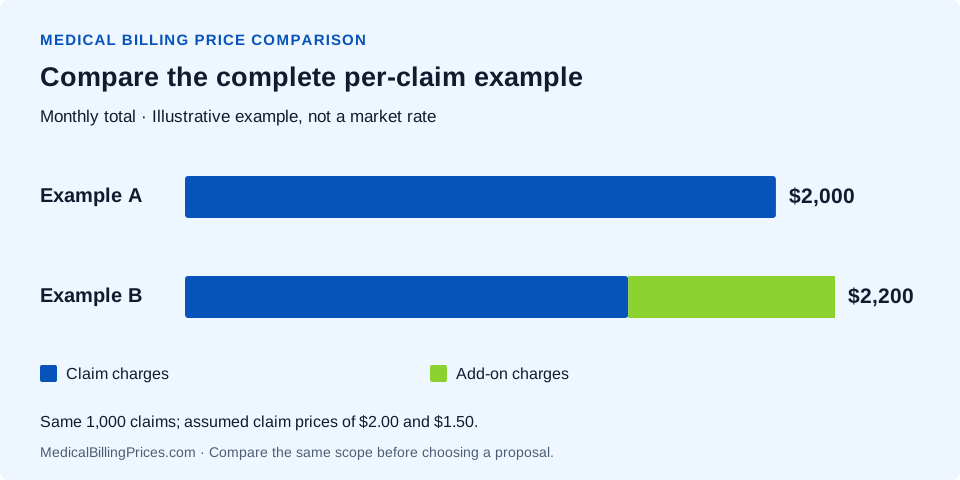
Read the example line by line
- Illustrative monthly claims: Example A uses 1,000; Example B uses 1,000. Check this line against the written proposal before carrying it into your own estimate.
- Illustrative claim price: Example A uses $2.00; Example B uses $1.50. Check this line against the written proposal before carrying it into your own estimate.
- Claim charges: Example A uses $2,000; Example B uses $1,500. Check this line against the written proposal before carrying it into your own estimate.
- Illustrative add-on charges: Example A uses $0; Example B uses $700. Check this line against the written proposal before carrying it into your own estimate.
- Illustrative monthly total: Example A uses $2,000; Example B uses $2,200. Check this line against the written proposal before carrying it into your own estimate.
The table is a narrow illustration of per-claim medical billing costs, not a complete practice budget. Its totals use only the line items shown. A company could price additional work differently, and your own workload may be substantially different. Do not transfer the example amounts into a purchase decision as if they were current medical billing prices. Instead, reproduce the layout with the offers your practice receives.
Run a second scenario before choosing
After completing the per-claim medical billing costs comparison at your expected workload, change one assumption at a time. Test a quieter period, a busier period or an additional service your practice may need. Ask the provider to confirm how its charge changes in that scenario. Changing one assumption makes it easier to identify whether the difference comes from the rate, the minimum, the scope or a separate charge.
If the order changes in your per-claim medical billing costs comparison between scenarios, keep both results. That does not make the comparison unreliable; it shows that the better-priced offer depends on the workload. Decide which scenario most closely reflects your expected use and which contractual terms would apply if your practice changes. Where a price depends on an unknown outcome, show the formula and leave the outcome as a scenario rather than claiming a fixed cost.
Look beyond the lowest headline price
Separate a rejected submission from an insurer’s payment decision when discussing price with a vendor. Ask the company to map its fee to each step in your actual workflow. If a task remains with your staff, record the expected work rather than assigning an invented dollar value. You can add your own labor cost using a consistent internal method.
The best price in your per-claim medical billing costs comparison is the offer that meets your stated needs at the most suitable total cost among the responses you receive. It is not a claim that one company is the cheapest in the entire market. Request comparable written proposals and check their validity dates before making a decision.
Per-claim medical billing costs: questions and answers
Does a per-claim fee include denied claims?
The contract must answer that. Ask whether rejected, corrected, denied and resubmitted claims each attract a fee and who performs follow-up. A submission price alone does not define a full-service billing offer.
How should a growing practice compare per-claim costs?
Request the written rate at several realistic monthly claim counts and check minimums and allowances. Keep the claim definition and service scope constant across the scenarios.
How do I get a useful current price?
Provide your practice size, approximate workload and the medical billing services you want priced. Ask for an itemized response with a date, scope, exclusions and contract term. Compare those responses using the same assumptions; this guide does not supply live provider rates.
What should I do with a quote that says “from” a claim price?
Ask which volume, services and conditions qualify for that price. Use the price your practice is actually offered rather than the lowest advertised starting figure. Request the same detail for minimums and other transactions.
Should I use paid claims to estimate a submission fee?
Only if the contract uses paid claims as its charging unit. If it charges on submission, estimate submissions. Matching the volume measure to the contract avoids understating costs when some submissions remain unpaid. Compare Medical Billing Prices Now.
Your price-comparison checklist
- Ask for the fee basis and every fixed or variable charge.
- Compare the same practice workload and included services.
- Record setup, minimums, renewal and exit charges.
- Request written prices and clarify exclusions before choosing.
Prepare a request that companies can price accurately
Write down your number of providers, approximate monthly claim volume, broad payer mix and current billing arrangement. Describe the exact work you want priced. A service handling only new submissions is a different purchase from one handling payment posting, follow-up and patient statements. Avoid sharing patient names, medical records or claim-level details in an initial price request.
Give every company the same brief. Ask it to mark included work, optional work and excluded work separately, with a price for each optional item. Record whether charges are one-time, recurring or volume-dependent. This simple structure lets your practice compare per-claim medical billing costs without having to guess what a short headline price covers.
Finally, ask how long the offer remains valid and what would change it. Save the dated proposal alongside the calculation you used. When an answer is unclear, leave the item open and ask the provider to clarify rather than inserting an assumed zero. A complete comparison can still contain unknowns; keeping them visible is more useful than producing a falsely precise total.
Review medical billing pricing models to put this fee into the complete comparison.
Further reading: CMS electronic billing guidance. Commercial comparisons above are editorial guidance; sources do not establish vendor prices.