Medical Billing Denial Management Fees: Compare Scope and Cost

Compare medical billing denial management fees using the same workload, included services and contract terms. A clear written price breakdown helps your practice identify the better value among the proposals it receives.
Separate routine follow-up from special projects
Ask whether your standard medical billing service price includes denial review, corrected claims and appeals. An existing backlog may be priced differently from ongoing work. Compare medical billing denial management fees against a written list of tasks and the balances covered.
Ask how a recovery fee is measured
If a company proposes a medical billing percentage fee on recovered collections, confirm which payments count, how attribution works and whether there is medical billing monthly minimum fee or a fixed project charge. Avoid comparing two recovery percentages without checking the accounts, time window and work included.
Compare reporting with the price
Ask what reporting accompanies the medical billing denial management service, how often it is delivered and who acts on recurring issues. Request a sample with private information removed. Useful reporting should let your team understand the work completed and the next responsibilities without assuming any guaranteed collection result.
Build a matched request for prices
Give each provider the same aggregate backlog size, age bands and broad payer mix without sending patient information through a price request. Ask for the medical billing pricing model, exclusions and contract period. Matched inputs make medical billing denial management fees easier to compare.
Compare denial work by account population
Define the backlog before requesting prices
Prepare an aggregate description of the accounts to be considered, including broad age bands and payer mix where you can provide them accurately. Ask the provider which accounts it will accept and which are excluded. Do not compare a proposal covering only recent denials with one covering a broad historical backlog as if the percentage alone explains the medical billing denial management cost.
Specify reporting and escalation
Ask how the company records work performed and how it requests documentation or decisions from your team. A denial service may depend on timely practice input. Include reporting frequency and the contact process in the medical billing company price comparison, along with any additional medical billing denial management fees. A fee is more interpretable when your team knows how progress and unresolved responsibilities will be presented.
Clarify the end of the engagement
For a time-limited project, ask when the service ends, how open accounts are handed back and how subsequent payments are treated. Confirm how the company calculates its fee if payment arrives after its work stops. Keep the written attribution rules with the quoted rate so that a later invoice can be checked against the same agreement. Compare Medical Billing Prices Now.
Medical Billing Denial Management Fees: an illustrative cost comparison
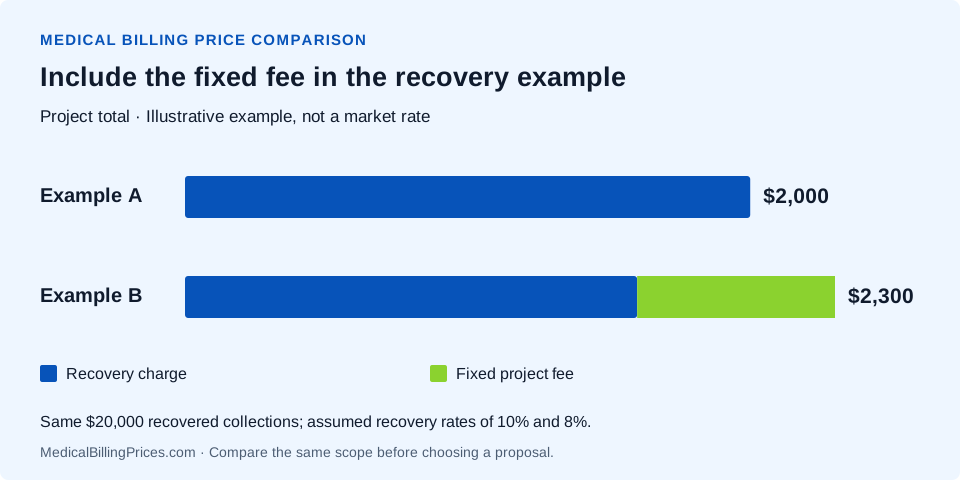
The table below uses invented figures solely to demonstrate a comparison method. These are not typical rates, current market prices or offers from providers. Replace them with written prices and your practice’s own specified backlog and recovered collections.
| Cost component | Example A | Example B |
|---|---|---|
| Illustrative recovered collections | $20,000 | $20,000 |
| Illustrative recovery fee | 10% | 8% |
| Calculated recovery charge | $2,000 | $1,600 |
| Illustrative fixed project fee | $0 | $700 |
| Illustrative project total | $2,000 | $2,300 |
Read the example line by line
- Illustrative recovered collections: Example A uses $20,000; Example B uses $20,000. Check this line against the written proposal before carrying it into your own estimate.
- Illustrative recovery fee: Example A uses 10%; Example B uses 8%. Check this line against the written proposal before carrying it into your own estimate.
- Calculated recovery charge: Example A uses $2,000; Example B uses $1,600. Check this line against the written proposal before carrying it into your own estimate.
- Illustrative fixed project fee: Example A uses $0; Example B uses $700. Check this line against the written proposal before carrying it into your own estimate.
- Illustrative project total: Example A uses $2,000; Example B uses $2,300. Check this line against the written proposal before carrying it into your own estimate.
The table is a narrow illustration of medical billing denial management fees, not a complete practice budget. Its totals use only the line items shown. A company could price additional work differently, and your own workload may be substantially different. Do not transfer the example amounts into a purchase decision as if they were current medical billing prices. Instead, reproduce the layout with the offers your practice receives.
Run a second scenario before choosing
After completing the medical billing denial management fees comparison at your expected workload, change one assumption at a time. Test a quieter period, a busier period or an additional service your practice may need. Ask the provider to confirm how its charge changes in that scenario. Changing one assumption makes it easier to identify whether the difference comes from the rate, the minimum, the scope or a separate charge.
If the order changes in your medical billing denial management fees comparison between scenarios, keep both results. That does not make the comparison unreliable; it shows that the better-priced offer depends on the workload. Decide which scenario most closely reflects your expected use and which contractual terms would apply if your practice changes. Where a price depends on an unknown outcome, show the formula and leave the outcome as a scenario rather than claiming a fixed cost.
Look beyond the lowest headline price
Have each provider identify which accounts it will accept and what information it needs before starting. Keep the initial price request at an aggregate level. If a later service requires patient information, use the provider’s appropriate secure process rather than including those details in a general comparison form. Ask how disputed fees or attribution questions will be resolved.
The best price in your medical billing denial management fees comparison is the offer that meets your stated needs at the most suitable total cost among the responses you receive. It is not a claim that one company is the cheapest in the entire market. Request comparable written proposals and check their validity dates before making a decision.
Medical billing denial management fees: questions and answers
Is denial management included in medical billing fees?
It may be included, limited or separately priced. Ask about routine denials, appeals, old backlogs and documentation-related tasks. Compare the written scope rather than assuming the service name covers every action.
Can a recovery percentage guarantee payment?
No. A fee basis does not guarantee payer payment or a collection outcome. Compare the work, reporting and contract terms without treating projections as promised results.
How do I get a useful current price?
Provide your practice size, approximate workload and the medical billing services you want priced. Ask for an itemized response with a date, scope, exclusions and contract term. Compare those responses using the same assumptions; this guide does not supply live provider rates.
How do I compare a fixed project fee with a recovery percentage?
Estimate the percentage fee at several hypothetical recovered amounts and add any minimum or fixed charge. Compare that range with the fixed offer for the same accounts and work. Treat recovery amounts as scenarios, not forecasts.
Should I choose a provider that promises the biggest recovery?
Ask what supports the projection and whether it is a contractual commitment or an estimate. Compare scope, price and reporting without treating an unsupported recovery claim as a demonstrated outcome. Compare Medical Billing Prices Now.
Your price-comparison checklist
- Ask for the fee basis and every fixed or variable charge.
- Compare the same practice workload and included services.
- Record setup, minimums, renewal and exit charges.
- Request written prices and clarify exclusions before choosing.
Prepare a request that companies can price accurately
Write down your number of providers, approximate monthly claim volume, broad payer mix and current billing arrangement. Describe the exact work you want priced. A service handling only new submissions is a different purchase from one handling payment posting, follow-up and patient statements. Avoid sharing patient names, medical records or claim-level details in an initial price request.
Give every company the same brief. Ask it to mark included work, optional work and excluded work separately, with a price for each optional item. Record whether charges are one-time, recurring or volume-dependent. This simple structure lets your practice compare medical billing denial management fees without having to guess what a short headline price covers.
Finally, ask how long the offer remains valid and what would change it. Save the dated proposal alongside the calculation you used. When an answer is unclear, leave the item open and ask the provider to clarify rather than inserting an assumed zero. A complete comparison can still contain unknowns; keeping them visible is more useful than producing a falsely precise total.
Review medical billing service prices to put this fee into the complete comparison.
Further reading: CMS electronic billing guidance. Commercial comparisons above are editorial guidance; sources do not establish vendor prices.