Medical Billing Percentage Fees: Compare What the Rate Includes

Compare medical billing percentage fees using the same workload, included services and contract terms. A clear written price breakdown helps your practice identify the better value among the proposals it receives.
Compare the fee base before the percentage
A lower percentage does not establish a lower total bill. Ask whether the medical billing percentage fee applies to insurance payments, patient payments, old accounts receivable or collections the practice handles itself. Record the same billing base for every provider so that two rates can be compared fairly.
Calculate a like-for-like monthly cost
For illustration only, a 5% fee on $100,000 of billable collections is $5,000. This is arithmetic, not a market price or provider offer. Add fixed charges and excluded work before comparing that total with a monthly medical billing price proposal. Use your own collection figures and each provider’s written terms.
Ask what happens after a denial
Ask whether the percentage fee includes medical billing denial management, corrected claims, appeals and patient follow-up. A percentage price that excludes these tasks cannot be compared directly with a broader service. Request a written scope and a separate price for anything your team must still do.
Check minimums and the exit terms
Medical billing monthly minimum fees can change the effective percentage when collections fall. Ask about annual increases, termination notice, post-termination collections and medical billing contract exit costs for returning your data. Compare the complete medical billing percentage fees under an ordinary month and a lower-volume month.
Choose a percentage using your collection pattern
Separate new work from old receivables
Ask the company to distinguish new claims it will submit from balances already on your books. If the proposed medical billing percentage fee applies to both, ask how the handover date and accounts will be identified. A practice comparing a new-claims-only offer with a full-receivables offer is comparing different purchases. Compare medical billing service prices for the scope you actually intend to transfer, then keep that scope fixed across the remaining proposals.
Understand the interaction with patient balances
A proposal may distinguish insurance collections from patient payments. Ask what work is included for statements, follow-up and payment posting, and which payments enter the medical billing percentage fee calculation. Do not assume that money deposited directly into the practice account falls outside the fee. Write the provider’s definition next to the quoted rate so that the expected invoice can be reproduced from the same records.
Ask for a sample invoice
Request a sample using hypothetical practice figures rather than someone else’s private financial information. The sample should show the collection base, the medical billing percentage fee, any minimum, all additional charges and the final amount. Compare it with the proposal. If a salesperson’s verbal explanation differs from the example, ask for the document to be corrected before you use it to choose a company. Compare Medical Billing Prices Now.
Medical Billing Percentage Fees: an illustrative cost comparison
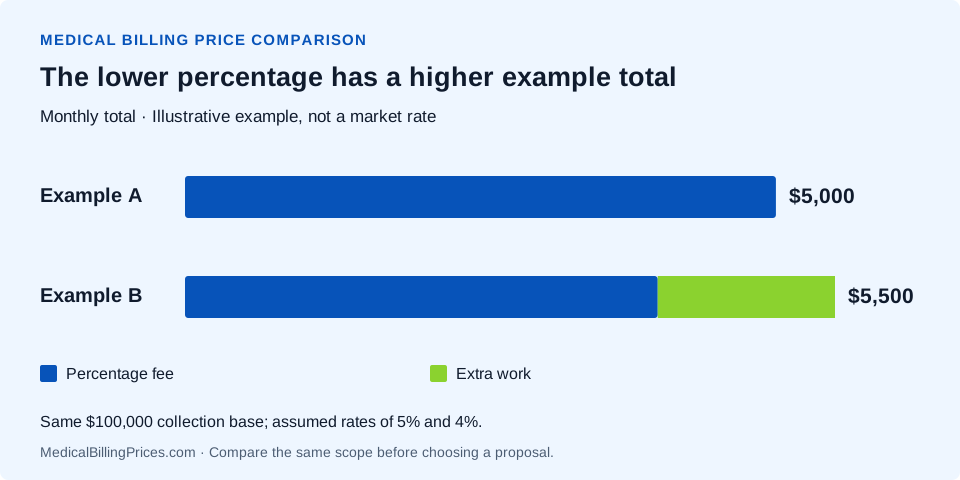
The table below uses invented figures solely to demonstrate a comparison method. These are not typical rates, current market prices or offers from providers. Replace them with written prices and your practice’s own billable collections.
| Cost component | Example A | Example B |
|---|---|---|
| Monthly billable collections | $100,000 | $100,000 |
| Illustrative percentage | 5% | 4% |
| Calculated percentage fee | $5,000 | $4,000 |
| Illustrative extra work | $0 | $1,500 |
| Illustrative monthly total | $5,000 | $5,500 |
Read the example line by line
- Monthly billable collections: Example A uses $100,000; Example B uses $100,000. Check this line against the written proposal before carrying it into your own estimate.
- Illustrative percentage: Example A uses 5%; Example B uses 4%. Check this line against the written proposal before carrying it into your own estimate.
- Calculated percentage fee: Example A uses $5,000; Example B uses $4,000. Check this line against the written proposal before carrying it into your own estimate.
- Illustrative extra work: Example A uses $0; Example B uses $1,500. Check this line against the written proposal before carrying it into your own estimate.
- Illustrative monthly total: Example A uses $5,000; Example B uses $5,500. Check this line against the written proposal before carrying it into your own estimate.
The table is a narrow illustration of medical billing percentage fees, not a complete practice budget. Its totals use only the line items shown. A company could price additional work differently, and your own workload may be substantially different. Do not transfer the example amounts into a purchase decision as if they were current medical billing prices. Instead, reproduce the layout with the offers your practice receives.
Run a second scenario before choosing
After completing the medical billing percentage fees comparison at your expected workload, change one assumption at a time. Test a quieter period, a busier period or an additional service your practice may need. Ask the provider to confirm how its charge changes in that scenario. Changing one assumption makes it easier to identify whether the difference comes from the rate, the minimum, the scope or a separate charge.
If the order changes in your medical billing percentage fees comparison between scenarios, keep both results. That does not make the comparison unreliable; it shows that the better-priced offer depends on the workload. Decide which scenario most closely reflects your expected use and which contractual terms would apply if your practice changes. Where a price depends on an unknown outcome, show the formula and leave the outcome as a scenario rather than claiming a fixed cost.
Look beyond the lowest headline price
For a useful sensitivity check, repeat the calculation at lower and higher collection levels. A percentage fee changes with the billable base, while a fixed add-on remains. Ask the company to explain which changes in practice volume or scope would trigger a new rate. Keep that explanation with the pricing sheet so future bills can be reconciled against the original offer.
The best price in your medical billing percentage fees comparison is the offer that meets your stated needs at the most suitable total cost among the responses you receive. It is not a claim that one company is the cheapest in the entire market. Request comparable written proposals and check their validity dates before making a decision.
Medical billing percentage fees: questions and answers
Is a lower medical billing percentage always cheaper?
No. A lower rate can produce a higher total when the billing base is broader, minimums apply or important services cost extra. Compare an itemized monthly total using the same collections and workload.
Which collections should I include?
Use the exact definition in the proposal. Ask specifically about patient payments, old receivables and payments collected by your own staff; do not assume these are treated alike.
How do I get a useful current price?
Provide your practice size, approximate workload and the medical billing services you want priced. Ask for an itemized response with a date, scope, exclusions and contract term. Compare those responses using the same assumptions; this guide does not supply live provider rates.
Can I compare percentage and flat-fee proposals?
Yes. Estimate each offer at the same billable collection levels and service scope. Keep variable add-ons visible and show the flat fee separately. The comparison will be specific to your assumptions; it does not establish a universally better pricing model.
What if collections increase after changing companies?
A percentage-based invoice may rise with its billable base. That does not by itself show the service became more expensive per dollar collected. Compare the agreed rate, the work performed and the total financial outcome without assuming the billing company caused every change in collections. Compare Medical Billing Prices Now.
Your price-comparison checklist
- Ask for the fee basis and every fixed or variable charge.
- Compare the same practice workload and included services.
- Record setup, minimums, renewal and exit charges.
- Request written prices and clarify exclusions before choosing.
Prepare a request that companies can price accurately
Write down your number of providers, approximate monthly claim volume, broad payer mix and current billing arrangement. Describe the exact work you want priced. A service handling only new submissions is a different purchase from one handling payment posting, follow-up and patient statements. Avoid sharing patient names, medical records or claim-level details in an initial price request.
Give every company the same brief. Ask it to mark included work, optional work and excluded work separately, with a price for each optional item. Record whether charges are one-time, recurring or volume-dependent. This simple structure lets your practice compare medical billing percentage fees without having to guess what a short headline price covers.
Finally, ask how long the offer remains valid and what would change it. Save the dated proposal alongside the calculation you used. When an answer is unclear, leave the item open and ask the provider to clarify rather than inserting an assumed zero. A complete comparison can still contain unknowns; keeping them visible is more useful than producing a falsely precise total.
Review medical billing pricing models to put this fee into the complete comparison.
Further reading: CMS electronic billing guidance. Commercial comparisons above are editorial guidance; sources do not establish vendor prices.