Medical Billing Coding Support Fees: Compare the Included Review

Medical billing coding support fees. Coding support can describe several different purchases. Comparing fees requires a clear answer about who assigns codes, who reviews documentation and which corrections the billing company actually performs. Compare medical billing prices for your requirements.
Name the coding task your practice needs
Separate code assignment from reviewing submitted codes, checking claim edits and answering documentation questions. A company offering claim submission may expect your practice to provide completed coding. Another proposal may include a defined coding review. Those prices purchase different responsibilities.
Describe the specialty, encounter types and expected monthly workload in aggregate. Ask which service lines the proposed team will handle and which require a separate specialist. Keep unsupported assumptions about automatic coding or clinical documentation out of the fee comparison.
A useful next step is to compare prices for the complete scope.
For the related scope, review medical billing prices by specialty alongside this comparison.
Compare the unit behind coding support prices
Request the exact counted unit and a worked invoice. If the quote uses encounters, charts, hours or a fixed scope, ask how complicated cases, additional procedures and corrected records are counted. The appropriate comparison uses the same workload rather than multiplying unrelated units.
Keep a list of included review activities beside each quoted amount. Ask whether an unanswered documentation query pauses the task, generates another charge or returns responsibility to your practice. A price is easier to evaluate when the company explains both the normal case and a defined exception.
Ready to put the components side by side? Request prices based on the same requirements.
Identify what happens after an edit or denial
Ask whether correcting a coding-related edit is included in the original review or starts a separate assignment. Identify who contacts the clinician, who approves a correction and who resubmits the claim. Your practice needs the work sequence as well as the fee.
Do not assume every denial proves a coding error or that paying for review guarantees payment. Price the documented activity the company will perform. Ask for examples of reporting categories and escalation steps without requesting another customer records or confidential results.
Use the exclusions in your proposal when you compare prices for the options that fit.
For the related scope, review medical billing company prices alongside this comparison.
Keep coding quality and price in the same decision
Ask what qualifications and review arrangements apply to the work being offered. The company should explain its proposed coverage for your specialty and how your practice can raise questions. Avoid paying for a broad label when only a narrow edit check is included.
Compare proposals against the same sample workflow using fictional or properly de-identified information through an appropriate channel. Record the tasks, turnaround commitments actually offered and unresolved responsibilities. The best fit is a clearly defined service your team can use, with coding support fees that reproduce the agreed scope.
Bring the final specification together and compare the complete quoted prices.
Medical Billing Coding Support Fees worksheet
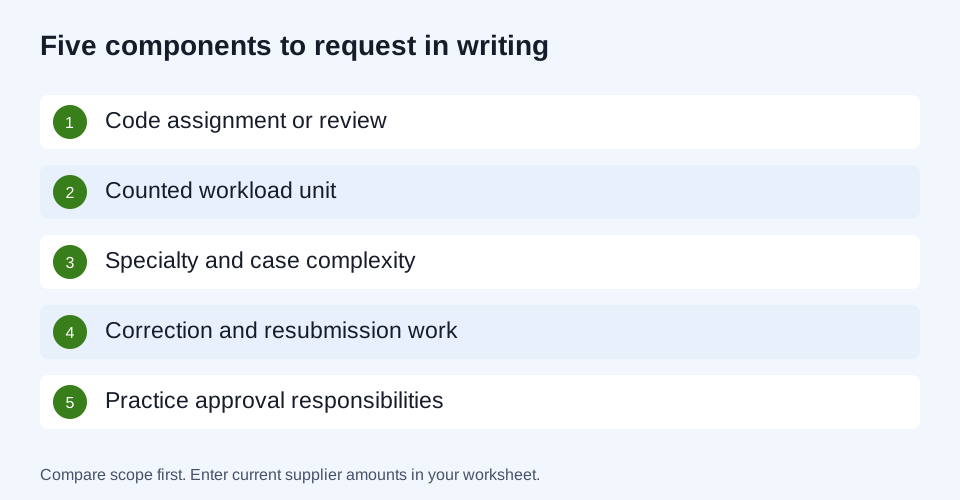
Keep a separate line for each component below. Ask both suppliers to use the same quantities and assumptions. Enter the current quoted amount, its billing unit and the work included. Leave an unanswered item open until the supplier responds; do not enter zero simply because the first proposal does not mention it.
| Component | Offer A | Offer B | Comparison question |
|---|---|---|---|
| Code assignment or review | Enter quoted amount and unit | Enter quoted amount and unit | Does each amount buy the same scope? |
| Counted workload unit | Enter quoted amount and unit | Enter quoted amount and unit | What preparation or equipment is excluded? |
| Specialty and case complexity | Enter quoted amount and unit | Enter quoted amount and unit | Is this fixed, recurring or usage based? |
| Correction and resubmission work | Enter quoted amount and unit | Enter quoted amount and unit | What assumption changes this charge? |
| Practice approval responsibilities | Enter quoted amount and unit | Enter quoted amount and unit | Who confirms the final included work? |
Read the five lines before choosing
Code assignment or review. Distinguish assigning codes from reviewing codes the practice already supplies. Ask whether the quote includes documentation queries and who resolves them. A review-only service should not be priced against complete coding work without showing the work your team retains.
Counted workload unit. Ask what counts as a priced unit: a chart, encounter, procedure or defined review. Describe mixed or multi-procedure work and request the counting rule. Use one consistent workload list so different billing units do not hide the total charge.
Specialty and case complexity. Identify the specialties and case types in the actual assignment. Ask whether complex records, missing documentation or particular review requests receive another price. Keep the scope specific; a broad routine-work price does not establish the cost of every case.
Correction and resubmission work. Separate correcting a code from correcting a rejected claim and resubmitting it. Ask who identifies the problem and whether repeat work is included. Compare both the coding deliverable and the downstream responsibilities the billing company accepts.
Practice approval responsibilities. Identify who approves code changes and answers documentation questions. Ask how the service records a query and returns it to the practice. The commercial comparison should reflect staff time required for approval without treating outside support as a substitute for complete clinical documentation.
For another component of the billing budget, review medical billing denial management fees and keep that scope separate when the supplier itemizes the proposal.
Compare one expected case and one changed case
First calculate the total using the workload and scope you actually expect. Then ask each supplier to price one plausible change that matters to this purchase, such as a different quantity, longer period or additional required work. Use the same change for both proposals. This reveals which line changes without relying on an invented market average or assuming the opening price applies to every situation.
Keep a written distinction between the quoted total and your own planning estimate. Where a cost is not yet confirmed, identify the open question and request an answer before treating the comparison as complete. The objective is a usable purchasing decision: a defined requirement, a comparable price and a clear explanation of what happens next.
Use your completed worksheet to compare medical billing prices now and focus the discussion on the options that meet your needs.
Medical Billing Coding Support Fees questions
Does medical billing include coding?
The agreement must say. Claim submission, coding review and assigning codes from documentation are different services.
Can coding support have a separate fee?
Yes, when the company prices it separately. Ask what is already included so the same task is not counted twice.
Should I compare coding fees per chart or per claim?
Use the unit in each proposal and convert both to the same defined workload. Ask how corrections and complex cases are counted.
Have the main requirements ready? Get medical billing prices for your next decision. Keep the written scope beside each price so you can compare the whole offer.