Medical Billing Patient Statement Fees: Compare Print and Digital Costs
Medical billing patient statement fees. A patient statement price needs more detail than a per-piece number. Ask what creates the charge, which delivery channel it covers and whether the practice pays again when a balance generates another notice. Compare medical billing prices for your requirements.
Price the statement workflow, not just printing
Identify whether the proposed billing service includes statement preparation, electronic delivery, printing, postage and follow-up. A paper statement charge may cover a different set of tasks from a digital notification fee. Ask who confirms that the balance is ready to send and who suppresses notices when the account is under review.
Keep patient communication policy separate from a supplier sales description. Your practice should define the intended process and ask the company to price it. A cheaper item that leaves printing, mailing or balance review with your staff is a different comparison from an end-to-end statement arrangement.
A useful next step is to compare prices for the complete scope.
For the related scope, review medical billing service prices alongside this comparison.
Count repeated notices and returned mail
Ask how a second or third statement is counted. Request the billing treatment for duplicate notices, returned mail, address corrections and an electronic notice that is followed by paper. These are useful invoice questions even when the provider uses a monthly bundle.
Estimate activity from aggregate statement counts, not patient identifiers. Keep first notices and repeated notices separate in the worksheet. If the quote includes an allowance, ask whether it counts attempted deliveries, completed sends, accounts or individual documents and what happens above that allowance.
Ready to put the components side by side? Request prices based on the same requirements.
Separate statements from payment collection charges
A statement fee and a payment-processing fee purchase different functions. Ask whether the quoted amount includes the portal, electronic payment tools or only the notice. Keep transaction fees, processing arrangements and any optional payment feature in separate rows.
Do not infer that buying a statement service changes the practice patient obligations or collection policies. Ask who answers billing questions, corrects balances and records payments. Price the actual work performed by each party so a lower mailing amount does not conceal a larger unresolved administrative task.
Use the exclusions in your proposal when you compare prices for the options that fit.
For the related scope, review medical billing clearinghouse fees alongside this comparison.
Request a reproducible statement invoice
Give each company the same monthly paper and electronic volumes, repeat-notice assumptions and required workflow. Ask for the base charge, included activity, unit prices and outside postage or delivery charges. Have the company explain which amounts can change and how changes are communicated.
Review the total at your normal workload and a busier month. This is a sensitivity check using your own counts, not a prediction of future patient collections. Keep the agreed workflow attached to the proposal, then compare the complete monthly statement cost rather than the smallest advertised line item.
Bring the final specification together and compare the complete quoted prices.
Medical Billing Patient Statement Fees worksheet
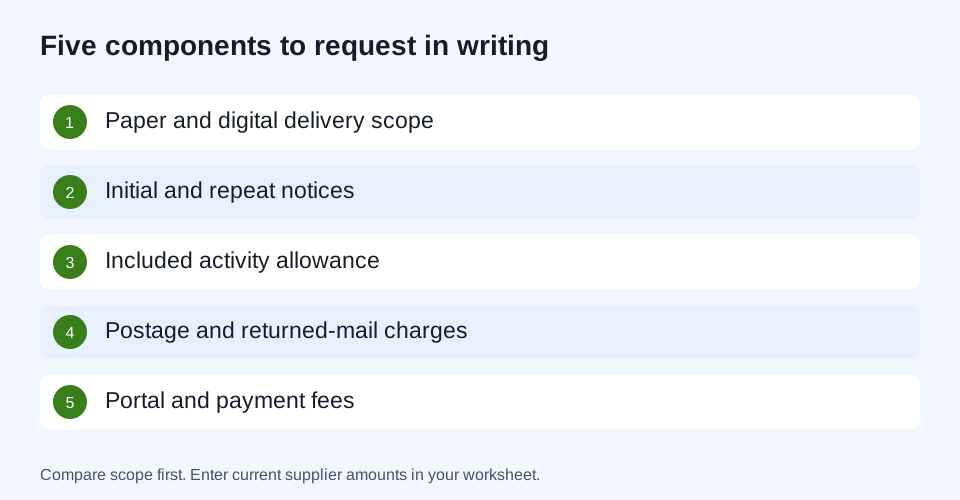
Keep a separate line for each component below. Ask both suppliers to use the same quantities and assumptions. Enter the current quoted amount, its billing unit and the work included. Leave an unanswered item open until the supplier responds; do not enter zero simply because the first proposal does not mention it.
| Component | Offer A | Offer B | Comparison question |
|---|---|---|---|
| Paper and digital delivery scope | Enter quoted amount and unit | Enter quoted amount and unit | Does each amount buy the same scope? |
| Initial and repeat notices | Enter quoted amount and unit | Enter quoted amount and unit | What preparation or equipment is excluded? |
| Included activity allowance | Enter quoted amount and unit | Enter quoted amount and unit | Is this fixed, recurring or usage based? |
| Postage and returned-mail charges | Enter quoted amount and unit | Enter quoted amount and unit | What assumption changes this charge? |
| Portal and payment fees | Enter quoted amount and unit | Enter quoted amount and unit | Who confirms the final included work? |
Read the five lines before choosing
Paper and digital delivery scope. Separate mailed statements, self-printed notices and digital delivery in the scope. Ask which delivery tools are included and which require another product. Compare the channels your practice intends to use rather than assuming all statement methods share one price.
Initial and repeat notices. Count initial notices and repeats separately. Ask whether a corrected or reissued statement creates another charge and how delivery failures are treated. Estimate activity using your own statement workflow, keeping the number of patients distinct from the number of notices sent.
Included activity allowance. Record the included statement allowance and the price beyond it. Ask whether unused allowances carry forward or simply expire. Compare the expected invoice at your actual notice volume, rather than treating an included allowance as an unlimited service.
Postage and returned-mail charges. Ask whether printing, envelopes and postage are combined or separate. Clarify returned-mail treatment and address correction work. A low software statement fee may exclude mailing work, while an outsourced mailing amount may combine several components that should be counted only once.
Portal and payment fees. Keep online portal access and payment processing separate from statement delivery. Ask which fees apply when patients view a balance or make a payment. Review the current payment terms independently so a statement price comparison does not accidentally conceal a different transaction cost.
For another component of the billing budget, review medical billing software add-on costs and keep that scope separate when the supplier itemizes the proposal.
Compare one expected case and one changed case
First calculate the total using the workload and scope you actually expect. Then ask each supplier to price one plausible change that matters to this purchase, such as a different quantity, longer period or additional required work. Use the same change for both proposals. This reveals which line changes without relying on an invented market average or assuming the opening price applies to every situation.
Keep a written distinction between the quoted total and your own planning estimate. Where a cost is not yet confirmed, identify the open question and request an answer before treating the comparison as complete. The objective is a usable purchasing decision: a defined requirement, a comparable price and a clear explanation of what happens next.
Use your completed worksheet to compare medical billing prices now and focus the discussion on the options that meet your needs.
Medical Billing Patient Statement Fees questions
Are patient statement fees included in billing prices?
Some proposals include a defined allowance or workflow; others price statements separately. Ask for the exact included scope.
Is a digital statement always free?
Do not assume that. Ask about delivery, portal, usage and any required base software charge.
How do I compare statement prices?
Use the same paper and electronic volumes, repeated notices and delivery tasks, then calculate the complete monthly charge.
Have the main requirements ready? Get medical billing prices for your next decision. Keep the written scope beside each price so you can compare the whole offer.